The Drawers - Mahmoud Meraji Commentary by Julie Oakes
 in the drawers
in the gallery
commentaries
artists
catalogs
contact
in the drawers
in the gallery
commentaries
artists
catalogs
contact
Figuration - 2009, Headbones Gallery
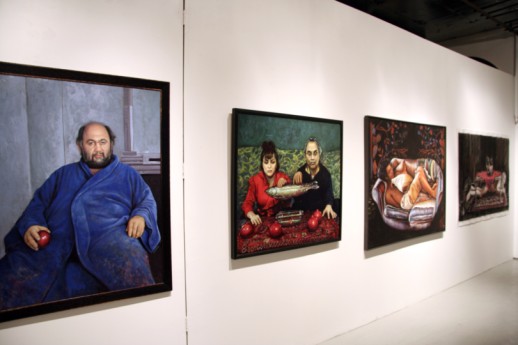 Mahmoud Meraji is exposing his cultural heritage and the changes that the
new lives that he has forged for himself and his family in Canada have
wrought. He frames his subjects within the context of his past; first in his
use of and reference to historical easel portraiture and second, by
positioning his figures in relation to Iranian customs.
Mahmoud Meraji is exposing his cultural heritage and the changes that the
new lives that he has forged for himself and his family in Canada have
wrought. He frames his subjects within the context of his past; first in his
use of and reference to historical easel portraiture and second, by
positioning his figures in relation to Iranian customs.
Easel painting was well known and respected in Iran since the late 1800's when the talented Iranian artist Kamal-ol-Molk, having studied in Paris, Florence and Versailles was appointed as the royal court painter to Nasereddin Shah. He introduced the European style and founded the Sanaye Mostazrafeh Art School, later known as the Kamal-ol-Molk Art School where the European style of painting was taught together with Iran's traditional painting. Kamal-ol-Molk trained highly competent students including Ali Mohammad Heidarian. The Modernist movement caught the imaginations of the next generation and produced world renowned artists such as Moshen Moghadam Vasiri.
Meraji has a dual art practice. He was included in the exhibition previous to Figuration at Headbones Gallery, (ab-strak'tid). He has used abstraction to further the release of his artistic identity within the Canadian context. The portraits, except for the fact that the sitters were often Iranian, did not overtly reveal his roots until the portrait titled Nostalgia completed in 2007 and included in the exhibition Canadians Without Borders at The Varley Gallery of Markham, Ontario. His son, Mehrad, sits with a crown of grass upon his head in front of a fish bowl. These are customary ritualistic items used in the celebration of the Iranian New Year but in the context of the European-style portrait they set up a surreal image. In Mirage the sense of a dream-like, psychological reality is carried even further as the artist and his wife, Amide seem suspended in séance, hands on the floating fish as if there is an answer within. Meraji's well developed expertise in portraiture becomes subservient to the imagery. No longer just an easel painting - there is a narrative beyond the identity of the sitters that is being imparted. It carries through in Mehrad a portrait of his son daydreaming where the plastic dream state appears to have eked through to virtual reality.
In Suicide, this transcendence becomes even more unique. The Farsi word for
self portrait is khod keshee. The word for suicide is khod koshee. Mahmoud
Meraji is diving under a table on which rests the ritual fish bowl on a
traditional piece of cloth. Caught between the Persian carpet and the
objects above he seems swept along by a current. His face is ashen white. He
is naked with the point of the table cloth covering his genitals. He states
that the reference to suicide is because he is killing his more conservative
self so that from the cocoon of tradition he can emerge, chrysalis-like, and
transform into a more liberated self.
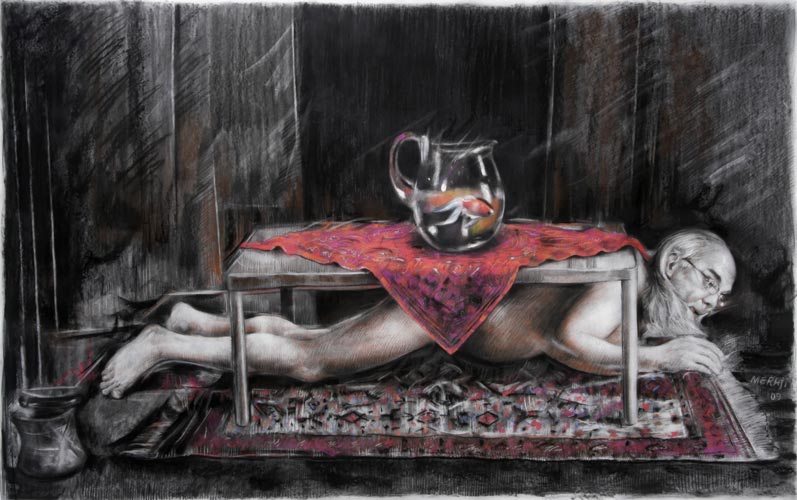
There is a jerky, spastic, fractured aura in Suicide. Just as a word embodies a complete definition, so does a picture. And just as Ab-strak-tid became more abstract in its phonetic form, so does this new Meraji surrealism separate itself from it's original meaning to form a new aspect of itself, more conceptual than the historical surrealists of Europe. Like the phonetic sur-real-ist; Meraji's surrealism is separate, broken apart, deconstructed and not quite in common usage yet.
Meraji's use of the figure can now be traced back to Persian miniature painting which speaks of the large questions about the nature of art and perception. There is a resonance between the miniature Mollahs in the Presence of Nasser-ed-Din Shah Qajar, executed in the Qajari style and Mirage for instance. Meraji has worked through the European style and gone back to posing psychological questions, figuring out the answers in a visual format.